The sewer line between your house and the city main is out of sight, so a break often goes unnoticed until it causes a backup. By then, the damage may include wet soil under the foundation, a sunken yard and a full-blown sewage backup in the basement. Spotting the early signs gives you a chance to repair the line before an emergency.
This guide lists the common warning signs, explains how a camera finds the break and describes the repair methods in plain terms. It also explains who is responsible for which part of the line, which is a question that often gets asked after the problem has already appeared.
Warning signs of a broken sewer line
| Sign | Why it happens | What to do |
|---|---|---|
| Gurgling drains and slow flow in several fixtures | A partial blockage or an offset pipe | Call for cable and camera. |
| Sewer smell in the yard or basement | A leak or a trap that has dried out | Check the floor drain trap, then call. |
| Lush green strip or soggy patch in the lawn | Wastewater leaking into soil | Call for a camera inspection. |
| Sinkhole or sunken area | Soil washing into a broken pipe | Keep people away, call. |
| Repeat clogs in the main | Roots or a bellied section | Camera and repair plan. |
| Rodents or insects in the house | A broken pipe offers a path | Inspect the line. |
Why sewer lines break
Old materials are the first cause. Clay pipe was joined with short sections that allow roots to enter at the joints. Cast iron corrodes from the inside and thins.
Orangeburg pipe, a tar-soaked fiber product used in the mid twentieth century, softens and deforms. Plastic pipe fails where the trench was poorly bedded or where the ground has moved.
Tree roots follow water and enter at any opening. Ground movement from freezing and thawing, construction nearby or heavy traffic over a shallow pipe can crack or offset a line. Heavy loads above a shallow line do the same.
How a plumber confirms and plans a repair
Clear the line if it is blocked
A cable or jetter opens the line so the camera can pass. See sewer line cleaning.
Camera and locate
The camera records the pipe from the cleanout, and a locator marks the depth and position of the damage on the surface.
Review the findings with you
You see the footage and learn the type of problem, such as a crack, a root intrusion, an offset or a collapse.
Choose a method
Spot repair, lining, bursting or a full replacement may apply, depending on the pipe and the damage.
Repair and verify
After the repair, a second camera pass confirms the line runs clean.
Questions to ask before approving a repair
- Can I see the camera footage and the location of the damage marked on the ground?
- Which repair methods apply to my pipe, and which do not?
- What is included in the price, such as restoration of the lawn or driveway?
- Does the work need a permit, and who handles it?
- What warranty is offered on the repair, and what does it cover?
Choosing between repair methods
A spot repair opens the ground at one location, cuts out the broken pipe and joins new pipe to the old. It is the least costly choice when the rest of the line is sound. Lining inserts a resin sleeve, built to ASTM International standards for cured-in-place pipe, into a pipe that still holds its shape, and it avoids a long trench. It does not fix a collapsed or severely offset pipe.
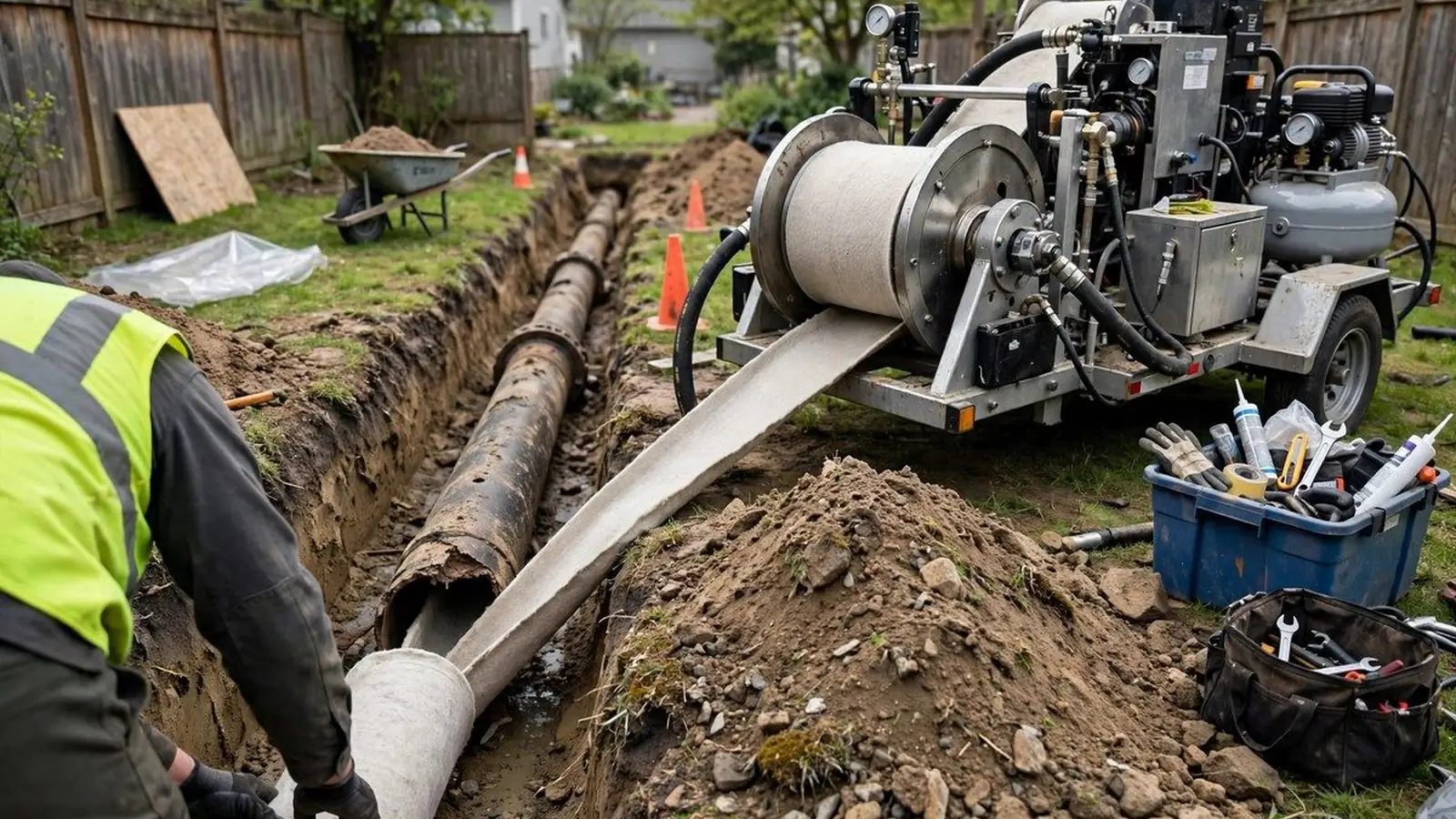
Pipe bursting pulls new pipe through the old line, breaking the old pipe as it goes. A full open trench replacement is the most disruptive and is chosen when the line is in poor condition throughout. Our sewer line repair page describes how each method fits.
What a repaired line should look like at the end
After any repair, the camera should run the full length of the new section and show smooth joints, a steady slope and no standing water. Ask for the recording, and keep it with your home records. It helps with resale and with any warranty claim.
The yard deserves attention too. Trench backfill settles over several weeks, so some topping up with soil and seed is normal. If the surface sinks by more than an inch or two after a rain, tell the contractor, because that can point to a void in the backfill.
Who owns which part of the line in the Frankfort area
In most places the property owner is responsible for the line from the house to the connection with the sewer main, and the sewer provider is responsible for the main. Frankfort and the towns around it are served by different providers, and the rules can differ. Ask your sewer provider where its responsibility ends, and ask the local building department whether a permit is required for a repair.
The older neighborhoods near the Capitol and in South Frankfort were built long before plastic pipe, so a camera is a smart first step. Our Midway and Lawrenceburg pages explain how we serve towns beyond Frankfort.
Source type: local sewer provider guidance and municipal permit guidance
Questions we hear about broken sewer line repair
Several slow fixtures, a sewer smell, a soggy yard patch or repeated backups are the common signs. A camera confirms.
Most policies cover resulting damage in some cases, not the worn pipe itself. Ask your carrier about a sewer backup endorsement.
Limit water use. If the line is partly open, small amounts may pass, but a full break needs a stop.
A spot repair can take a day. A full replacement can take several days.
Generally the part from your house to the connection is yours. Confirm the boundary with your provider.