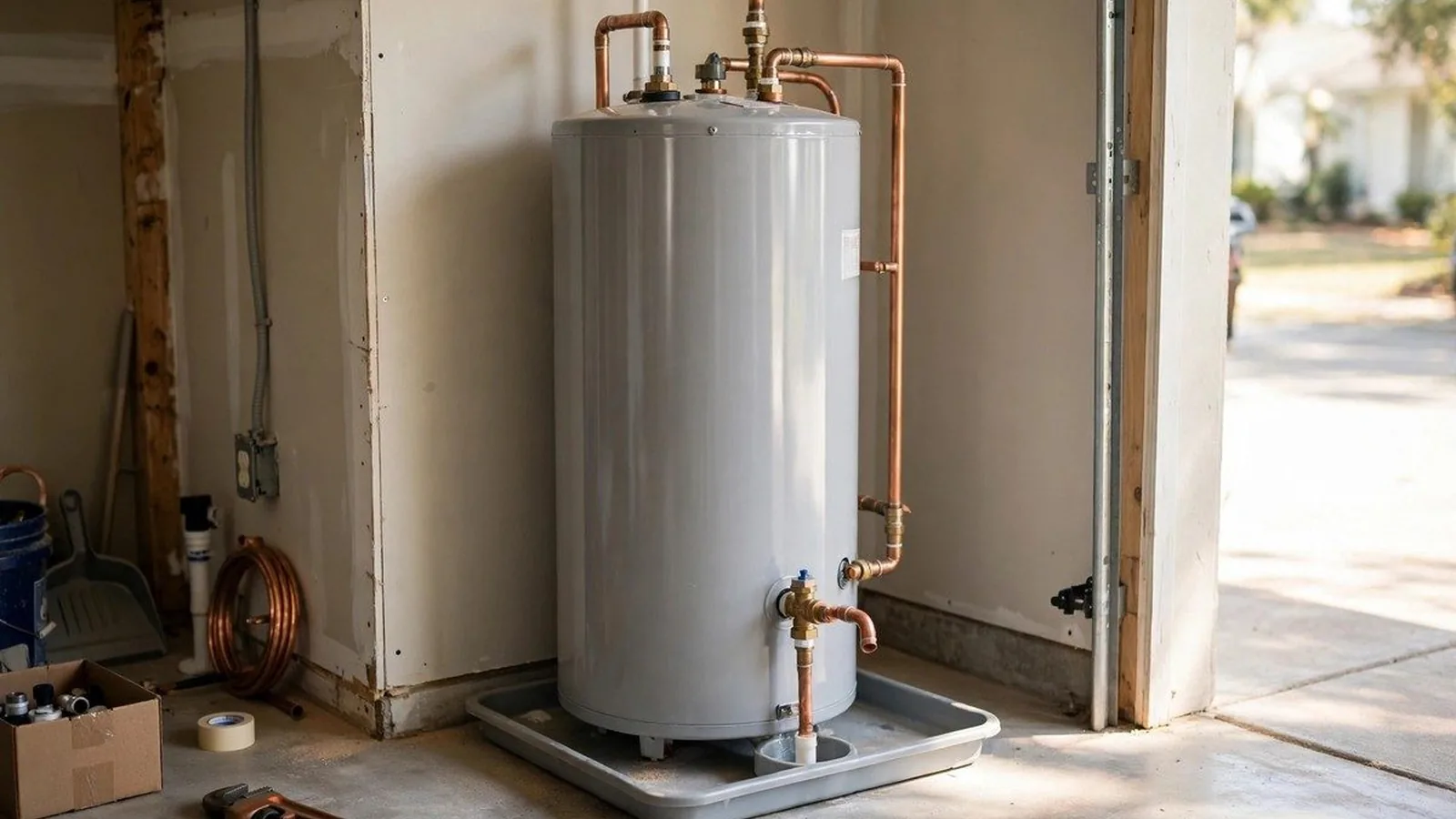
Emergency water heater replacement in Frankfort, KY is the right answer when the tank has split, the unit is well past its life, or repair costs have started to approach the price of a new heater. If your tank is leaking, shut the cold water inlet, switch off the power or gas, and call our 24/7 line. We will confirm what you have and arrange the swap as soon as we can.
Replacing a water heater means disconnecting and hauling away the old tank, setting a new one, reconnecting water, gas or electric supply, fitting a new relief valve and discharge line, checking venting on gas units and testing the finished work. Our water heater installation page covers the planned version of this job, and this page covers the failure that forces it.
Tank failed or flooding: first moves while help is on the way
- Close the cold water inlet valve on top of the tank. If it will not turn, close the main water valve for the house.
- Switch off the breaker for an electric heater, or turn a gas heater's control knob to off. Do not touch wet electrical parts.
- Open a hot tap upstairs to relieve pressure and let the tank drain slowly, or attach a hose to the drain valve and run it to a floor drain.
- Move boxes, rugs and stored items out of the water path. Take photos of the heater, the label and the damage for your records and any insurance claim.
- Call the 24/7 line and give us the tank size, fuel type, and the closet or garage location. We use that to bring the right unit on the first trip.
Repair or replace? How we decide
A heater that is leaking from the tank body cannot be repaired. A heater with a failed element or thermostat usually can, and if the tank is young that is often the better value. The harder cases sit in the middle: a unit near the end of its expected life with a repair needed that costs a large share of a new heater.
We give you both numbers on the same visit, plus the age of the tank from its date code and a plain recommendation. If a repair is worth doing, our water heater repair crews handle it. If it is not, we explain why.
Choosing the replacement: tank, tankless or hybrid
| Type | Good fit when | Things to weigh |
|---|---|---|
| Standard gas tank | Gas supply and venting are already in place | Fast recovery, needs a safe flue. |
| Standard electric tank | No gas line, simple swap | Slower recovery, simple install. |
| Tankless gas or electric | Space is tight or demand is steady | Higher upfront cost, scale care, see tankless options. |
| Hybrid heat pump tank | Utility rebates and room for airflow | Needs clearance and a condensate drain. |
The best choice depends on your house, not on a general rule. We confirm gas, electric, venting and space before you decide.
What a replacement visit includes
Confirm the swap
We check size, fuel, venting and clearances before touching the old tank, and we agree on the unit and the price.
Drain and remove
We drain the old tank, disconnect it and carry it out. Haul-away is part of the job.
Set and connect
The new heater goes in level on a proper pan where it is needed, with new flex connectors, a relief valve and a discharge line.
Gas and venting checks
On gas units we leak-test the connections, check draft at the vent and confirm the burner lights and shuts down correctly.
Fill, test, explain
We purge air, check for leaks under pressure, set the temperature, and show you the shutoff valves and the relief valve.
Permits and code in Kentucky
Water heater installs can involve plumbing, gas and electrical code, and permit rules vary, so ask the Frankfort building department what applies to your address. Kentucky licenses master and journeyman plumbers through the Department of Housing, Buildings and Construction, Division of Plumbing, under 815 KAR 20:030. You can verify any plumber's license with the department's license search at dhbc.ky.gov.
Whoever you hire, ask who pulls any required permit and how the work is inspected. That is a fair question for any contractor.
What decides the price of a replacement
Size and type of heater
A forty gallon tank and a tankless unit differ widely in unit price and in labor.
Fuel and venting
Gas units need venting checked or upgraded. Electric units may need a circuit check.
Code items
Expansion tank, drain pan, discharge line and sediment trap are added where the setup calls for them.
Access and distance
A basement stair, an attic or a tight closet changes labor.
After hours
Emergency dispatch outside normal hours carries an on-call charge, quoted before work starts.
Homeowner insurance often pays for water damage from a sudden failure but not for the heater itself. Ready for a quote? Call and we price it from the label details.
Questions we hear about water heater replacement
Yes. Replacement calls go through the same overnight dispatch. Timing depends on the schedule and stock, and if a unit has to be ordered we say so on the phone.
A standard like-for-like swap is usually a half day. Moving a unit, changing fuel or adding venting takes longer, and we tell you the expected time before starting.
If the tank is well past its typical life or has begun to leak at the seams, planning a replacement avoids a flood and an emergency premium. Check the date code on the label and call if you are unsure.
Yes. Removal and disposal of the old tank are part of the job.
Often yes, but it depends on your electrical panel, space and venting. We check those before recommending a change, and we explain what the change would involve.