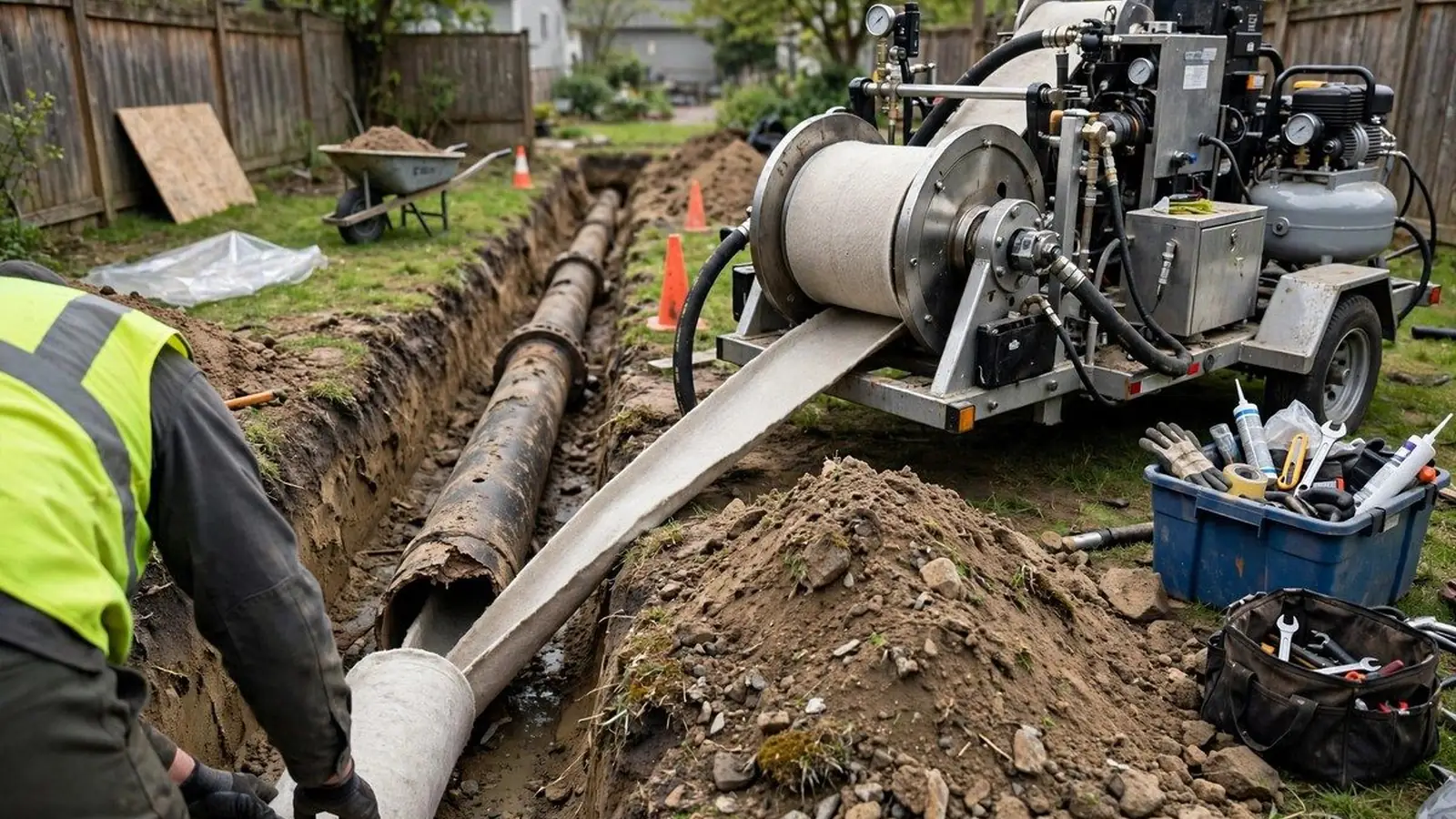
Emergency sewer line repair in Frankfort, KY covers the cracked, offset, root-filled or collapsed pipe that carries waste from your house to the city main or septic system. If sewage is backing up, stop using water, keep people and pets away from the wet area, and call our 24/7 dispatch line.
We confirm the cause with a camera before recommending a repair. Lining products are built to published ASTM International standards for cured-in-place pipe, and a contractor should be able to name the one a product meets.
A sewer line fails slowly or all at once. Slow failures show up as gurgling, repeated clogs and a faint sewer smell. A sudden failure, such as a collapse, shows up as water backing up in the lowest drain and a sinkhole or wet spot in the yard. The repair depends on where the line broke and what it is made of.
Sewage backing up: what to do right now
- Stop using sinks, tubs, toilets, dishwashers and washers. Every flush adds to the backup.
- Keep children and pets out of the affected area. Sewage carries bacteria that can make people sick.
- Do not run a wet vac in raw sewage unless it is rated for it, and wear gloves and boots if you must enter.
- If the backup reached electrical outlets or the panel, stay out and call 911 or your electric utility.
- Call your insurance agent and ask whether you carry a sewer backup endorsement. Photograph everything before cleanup.
How we find the break
A sewer repair starts with a diagnosis, not a dig. We run a camera through the cleanout and record the pipe from the house toward the main. The recording shows the material, the joints, any roots or offsets, a bellied section where the pipe has sunk and holds water, and the exact distance to the problem.
A locator tool on the camera head lets us mark the spot on the surface, so an excavation, if needed, opens the ground where the pipe is and nowhere else. That saves money and lawn. You also get a clear explanation of what we saw, which is useful for comparing options and for an insurance claim.
Repair options and when each fits
| Option | Best for | Things to weigh |
|---|---|---|
| Spot repair by excavation | One break or one bad joint | Opens a small area, fastest if the rest of the line is sound. |
| Full replacement by open trench | Long runs of failed pipe, bellies, heavy root damage | Most disruptive, resets the whole line. |
| Trenchless pipe lining | Cracked or root-prone pipe that still has its shape | Less digging, does not fix a collapsed or severely offset pipe. |
| Trenchless pipe bursting | Replacing a failed line along its existing path | Needs access pits at each end. |
| Cleanout installation | No access point for maintenance | Often paired with another repair. |
Which method is possible depends on what the camera shows. We tell you which options apply and which do not.
Old pipe under old Frankfort
Frankfort became the state capital in 1792, and neighborhoods near the Capitol, South Frankfort and the Corner in Celebrities Historic District have homes that date well back into the last two centuries. The sewer laterals serving them may be clay, cast iron or an old repair of some other material, and each of those fails differently.
Clay joints open and admit roots. Cast iron rusts from the inside and flakes. Mixed repairs from earlier owners can leave transitions that hold debris. A camera shows which problem you have, so you can decide between a spot repair and a larger project without guessing.
Who owns which part of the line
In most places the property owner is responsible for the lateral from the house to the connection at the main, and the utility is responsible for the main itself. The exact boundary and any permit rules vary, so ask your sewer provider and the local building department before work begins. We do not guess at that boundary, and we tell you if our camera shows the problem is in the utility's main instead of your lateral.
Septic systems are a separate case. If your home is outside the sewer service area, the failure may be in a septic tank, a baffle or a drain field, and the right contact may be a septic pumper or the county health department. We can help you work out which problem you have.
From backup to finished repair
Relieve the backup
If the line can be opened, we clear it first so the house is usable while the repair is planned. See hydro jetting and sewer line cleaning.
Camera and locate
We record the line and mark the depth and position of the failure.
Quote and choose a method
You get the options in writing with the price, so you can compare before work begins.
Repair and restore
We excavate or line the pipe, test the new section and return the site as agreed.
Final camera pass
We run the camera again to confirm the repaired line flows cleanly to the connection.
What shapes the cost of a sewer repair
Depth and length
A shallow spot repair is a small job. A deep or long run is a large one.
What is above the pipe
Lawn is the easiest to restore. Driveways, patios, trees and slab foundations add work.
Method
Excavation, lining and bursting use different equipment and crews.
Permits and inspection
Where a permit is required, it is part of the project. Ask us how it is handled.
After-hours dispatch
Emergency calls outside normal hours carry an on-call charge, stated before work.
Sewage backup coverage is usually an optional endorsement on a homeowner policy. Comparing quotes? Call and describe what you see.
Questions we hear about sewer line repair
Yes. Sewage in a basement is dispatched at any hour. Stop using water and call, and a plumber arrives with a camera to find the break.
A clog clears with a cable or jetter and stays clear. A broken line backs up again, often within days. A camera pass is the way to tell for certain.
Not always. Spot repairs open only a small area, and lining or pipe bursting can avoid a long trench when the pipe is suited to it. The camera tells us which methods apply.
Roots enter where a joint has opened, usually because the pipe is old or shifted. Cutting roots gives temporary relief. Repairing the joint stops them returning.
Usually the repair of a worn pipe is not covered, though resulting damage might be under a backup endorsement. Ask your carrier before work starts.
Yes. Sewer work is planned around each provider's rules, which differ by town. Local notes are on our pages for Lawrenceburg, Versailles and Midway.