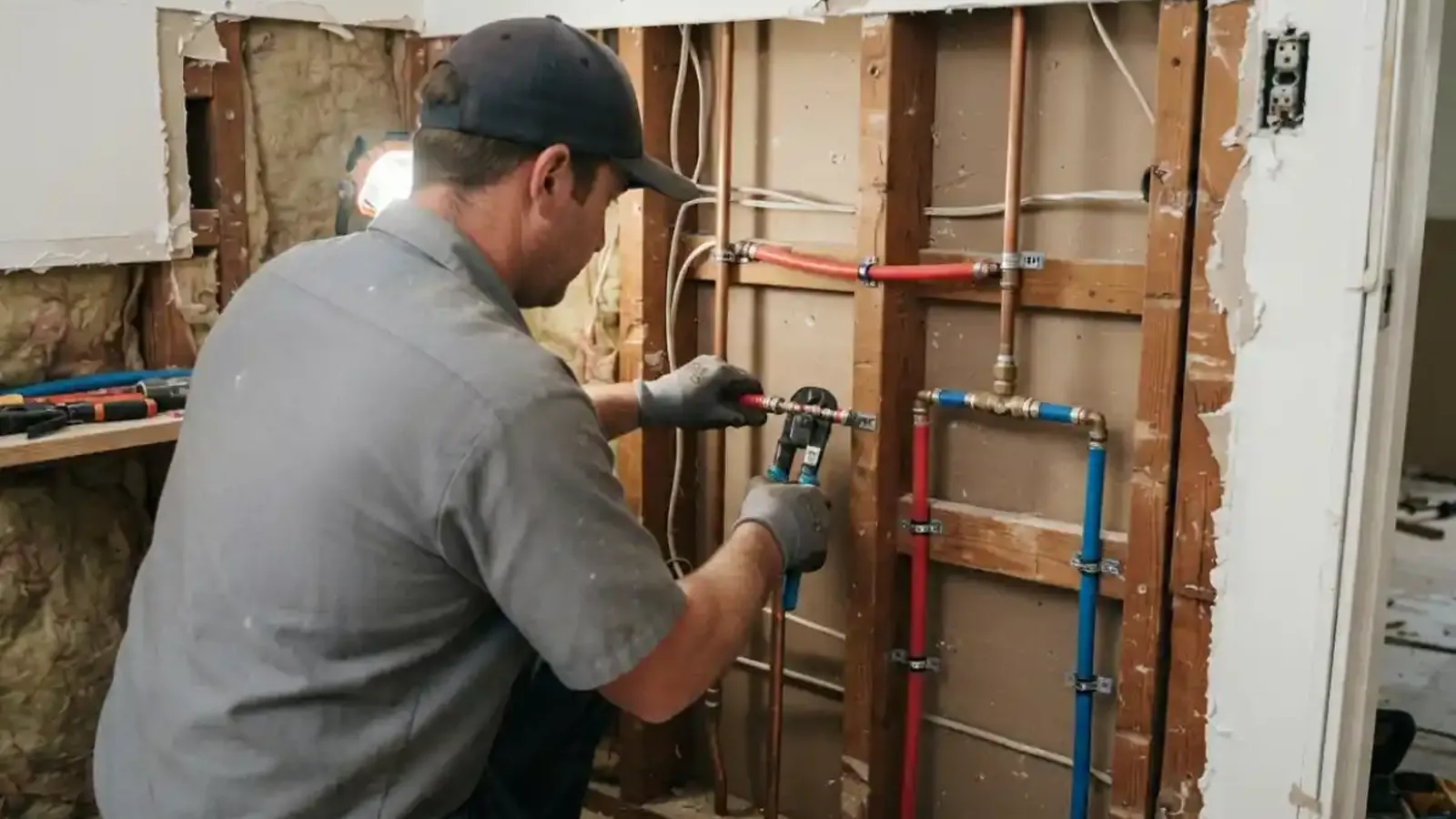
Repiping in Frankfort, KY means replacing the water supply pipes throughout a house, often because old galvanized steel has corroded or copper has developed pinhole leaks. If you have had two or three leaks in the same house within a year, rust-colored water, low pressure at multiple fixtures or visible corrosion at joints, repiping is worth pricing.
Repiping is a planned project, not an emergency, though an emergency may start it. If a pipe is spraying water right now, see burst pipe repair first. This page explains how to decide, what the work involves and what to expect.
Signs the pipes are failing as a system
| Sign | What it suggests | Action |
|---|---|---|
| Brown or orange water at start-up | Rust inside galvanized pipe | Plan a repipe. |
| Low pressure at several fixtures | Mineral buildup narrowing the pipe | Test pressure, plan a repipe. |
| Repeated pinhole leaks | Pitting corrosion in copper | Plan a repipe. |
| Green crust at joints | External corrosion | Spot repair now, plan a repipe. |
| Single leak in an otherwise healthy line | Isolated failure | Spot repair. |
Pipe materials and how they differ
Galvanized steel was common in houses built before the mid twentieth century. It corrodes from the inside, builds scale and narrows over decades, which cuts pressure and discolors water. Copper lasts a long time but can pit in some water conditions, and it is a high-cost material. Cross-linked polyethylene, known as PEX, is flexible, resists freeze splits better than rigid pipe, and is quick to install in tight spaces.
Which one suits your home depends on the house, the budget and local code. We explain the options and the trade-offs. The choice of material is yours to make with that information.
How a whole-house repipe works
Survey the house
We look at the pipe material, the layout, access in the attic, basement or crawl space, and the fixtures that will be reconnected.
Plan the route
New pipes follow a route that minimizes wall openings. Many houses can be done with small access holes.
Set up and replace
We shut off water, install the new lines and connect fixtures. Water is typically off for part of a day.
Test
We pressure test every run before the walls are closed.
Patch and restore
We patch the access holes. Painting is left to you unless we agree otherwise.
Old houses, new pipes in Frankfort
Frankfort's older neighborhoods, from South Frankfort to the Corner in Celebrities Historic District, have houses built when galvanized steel was standard. Many have been partly repiped over the years, which leaves a patchwork of materials. Joining different metals can cause corrosion where they meet, so we check the transitions and use the right fittings.
If you live in a historic district, ask whether any rules affect alterations to the house, and we plan access with that in mind. A short call to the city office before the walkthrough saves surprises.
Living in the house during a repipe
Most repipes are done room by room, so you keep water in part of the house for most of the day. We shut the supply while lines are cut over, and we tell you the hours in advance so you can fill containers and plan meals and showers. Expect some noise and dust, and plan to move furniture away from walls that will be opened.
At the end of each day we turn the water back on, check every connection under pressure and tell you what is finished and what remains. Patches in drywall are small, and painting them afterward is your job unless we agree otherwise in the written scope.
Pressure and flow before and after
People often notice the difference in a repiped house in the shower first. Galvanized pipe narrows from the inside as scale builds up, so a pipe that was three quarters of an inch across when new may carry far less water today. New pipe restores the full opening and the flow that goes with it.
We measure pressure before the work and again afterward, so you see the change in numbers and not only in how the water feels. If the pressure is high at the meter, a regulator is part of the project, since new pipe does not like pressure spikes any more than old pipe does.
What affects repiping cost
Size of the house
More fixtures and longer runs mean more pipe and more time.
Material
PEX, copper and CPVC differ in price and labor.
Access
Open basements and crawl spaces cost less than finished walls and slabs.
Number of stories
Multi-story homes need more routing.
Permits
Ask the building department what is needed. We tell you how it is handled.
Whole-house work is priced in writing. Need the price before you decide? Call, tell us about the house and we plan a walk-through.
Questions we hear about repiping
Many homes take one to three days depending on size and access. We give you an estimate of the time and the water-off periods before we start.
Usually yes, though you will be without water for part of each day. We tell you in advance which hours.
Typically not for worn-out pipe, though resulting water damage may be covered. Ask your carrier.
A single leak in good pipe is a spot repair. Repeated leaks in the same material are a sign the pipe is failing and repiping saves money in the long run.
Yes. Older houses in Midway's historic district and farmhouses near Lawrenceburg or Versailles are common repipe jobs for us.