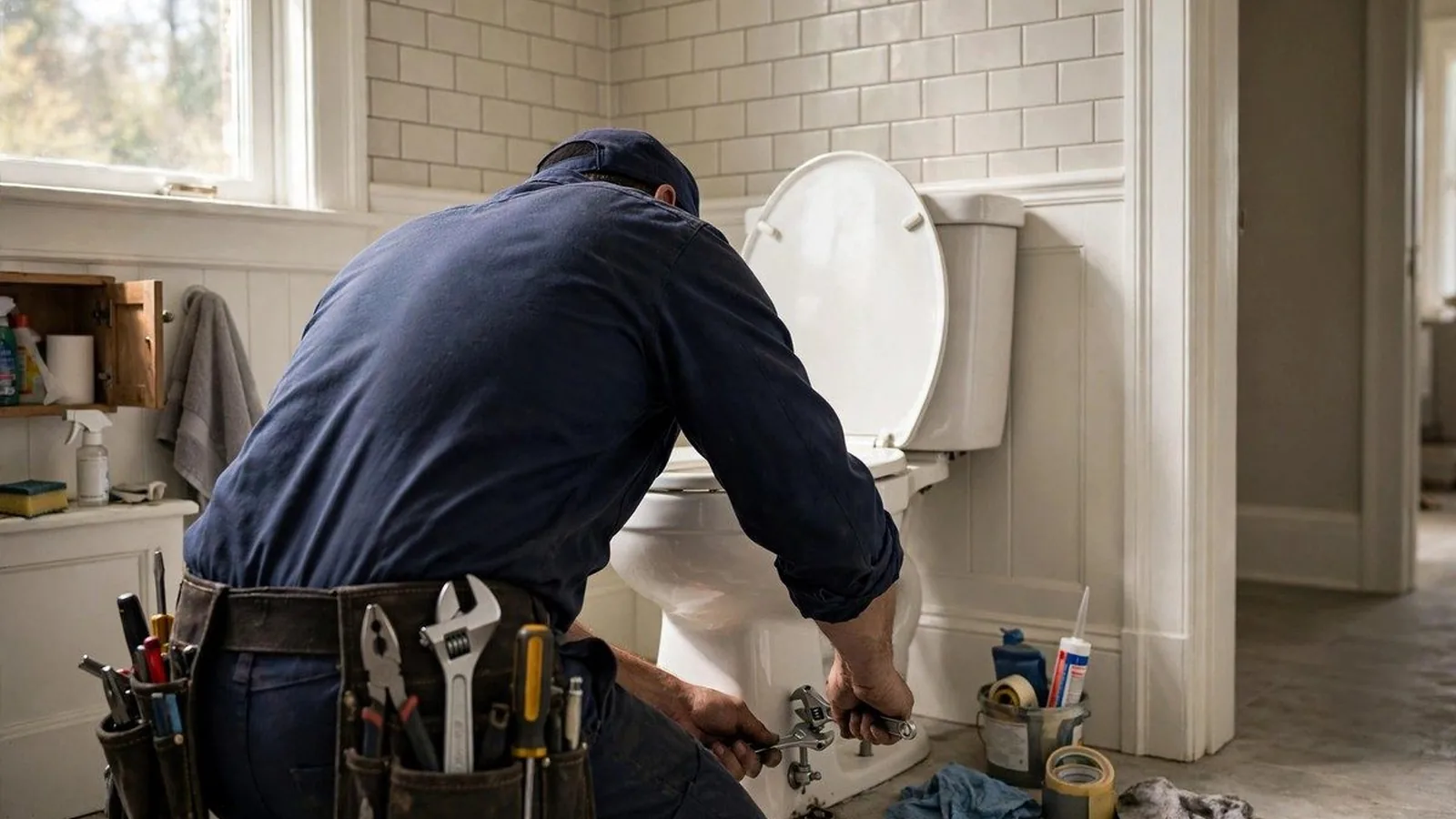
Emergency toilet repair in Frankfort, KY covers an overflowing bowl, a toilet that will not flush, a tank that keeps running and a base that leaks onto the floor. If water is rising, lift the tank lid, push the flapper down to stop more water from entering the bowl, and turn the supply valve behind the toilet clockwise to shut it. Then call our 24/7 line.
Most toilet problems come from a few small parts: the flapper, the fill valve, the wax ring and the trap. Replacing the failed part usually fixes the toilet, and we carry the common ones. When the bowl is cracked or the toilet is old and inefficient, we also install replacements.
Overflowing toilet: stop the water first
- Remove the tank lid and lift the float or press the flapper into its seat. This stops water entering the bowl.
- Turn the supply valve behind or beside the toilet clockwise until it closes. If it will not turn, close the main water valve for the house.
- Do not flush again. If the bowl is near the rim, let it settle.
- Put towels around the base and use a wet vac or mop to remove standing water. Wear gloves.
- If other drains are also slow, the main line may be blocked. Call us and say so.
Common toilet problems and the fix
| Problem | Likely cause | Fix |
|---|---|---|
| Runs on and off or hisses | Worn flapper or fill valve | Replace the part. |
| Weak flush | Clogged rim jets, low tank water or partial clog | Clean jets, adjust the water level, clear the trap. |
| Water at the base | Failed wax ring or loose closet bolts | Reset the toilet with a new wax ring. |
| Water on the floor from the tank | Cracked tank, loose tank bolts or bad supply line | Replace gaskets or line, replace a cracked tank. |
| Repeat clogs | Partial blockage in the drain or an undersized older toilet | Cable the line, consider jetting or replacement. |
| Phantom flush | Slow leak past the flapper | Replace the flapper and check the seat. |
A running toilet and your water bill
A toilet that runs even slightly can waste a large amount of water over a month. If your bill jumped and you cannot say why, test the toilets first. Add a few drops of food coloring to the tank, wait a short time without flushing, and look at the bowl. Color in the bowl means the flapper leaks.
If the toilets are fine, the leak is elsewhere, and our leak detection team can trace it with a meter test and listening equipment. Finding it early keeps the damage small.
What a toilet repair visit looks like
Diagnose
We check the water level, the flapper, the fill valve, the supply line and the base to find the failed part.
Repair
We replace the failed parts. If the toilet is lifted, we reset it on a fresh wax ring and tighten the bolts evenly.
Test
We flush several times, check the base and the supply for drips, and confirm the tank refills to the right level.
Advise
If the toilet is cracked, wobbly or very old, we tell you whether a replacement is the better value.
Choosing a replacement toilet
According to the EPA's WaterSense program, a labeled toilet uses 1.28 gallons per flush or less, and many newer models carry the label. The label means the toilet meets a set standard for water use and performance. A modern toilet in a house with older drain lines can still clog if the line has problems, so a toilet that clogs repeatedly deserves a look at the drain before the purchase.
If you are replacing, tell us the rough-in distance, which is the measurement from the wall to the center of the floor flange, and whether you prefer a round or elongated bowl. We can bring options to fit.
What shapes toilet repair pricing
Part or replacement
A flapper is inexpensive. A new toilet is a larger purchase.
Floor and flange condition
A rotted floor or damaged flange adds work.
Clog location
A clog in the trap is quick. A clog in the main line is a drain job.
After-hours dispatch
Emergency calls outside normal hours carry an on-call charge, stated first.
Want a straight price? Call, describe what the toilet is doing, and we quote it before we begin.
Questions we hear about toilet repair
Yes. An overflowing toilet is the sort of call we take at three in the morning. Shut the supply valve behind it first, and a plumber follows as soon as the schedule allows.
Usually the flapper no longer seals or the fill valve is out of adjustment. Both are small parts and are repaired quickly.
Not by itself, but it means the seal at the base may be failing and water could be reaching the floor. Have it checked soon, before the subfloor is damaged.
A flange plunger is safe and often works. Avoid chemical cleaners. If the plunger fails, call us. See our drain cleaning page for what happens next.
Yes. We remove the old toilet, set the new one on a new wax ring and test the seal.