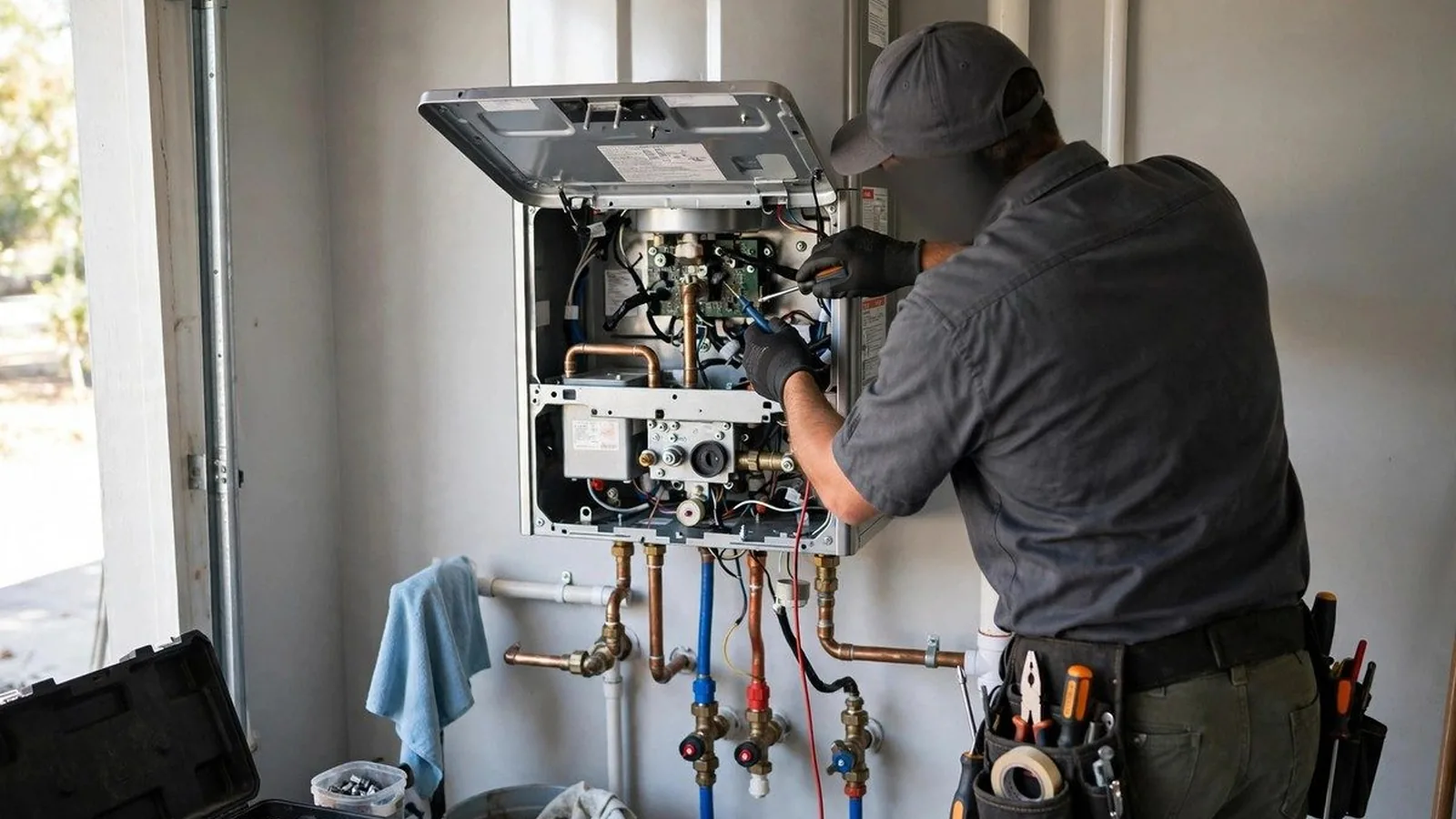
A tankless water heater holds very little water inside, which sounds like a good thing for freeze protection. In practice, the small passages of the heat exchanger can freeze and crack, and so can the pipes that connect it. Freeze protection exists on most units, but it usually needs electric power, and an ice storm that drops the temperature can also knock out the power.
This guide explains how freeze protection works, where the weak points are and what to do before a cold snap and after a freeze. If your unit is already frozen and leaking, close the water supply and the gas valve and call.
Where tankless systems freeze
| Part | Why it is at risk | Protection |
|---|---|---|
| Heat exchanger | Narrow passages hold a little water | Built-in heaters and drain-down valves, power needed. |
| Inlet and outlet pipes | Exterior walls and unheated spaces | Insulate and heat trace. |
| Condensate drain line | Water sits in the line and freezes | Insulation or heat trace, short run. |
| Venting | Frost can block a vent terminal | Keep the terminal clear of snow and ice. |
| Outdoor unit | Exposed to cold air | Unit rated for outdoor use and kept powered. |
How built-in freeze protection works
Most tankless units have a small heater or a recirculation routine that turns on when the internal temperature drops near freezing. The unit uses electricity to keep the heat exchanger warm. Some units also have a drain-down valve that empties the heat exchanger when it senses cold.
That protection fails when power fails. A unit with a power cord is only as safe as the outlet behind it. During an ice storm or a power outage in deep cold, the heat exchanger can freeze, and a frozen exchanger can crack. A battery backup or a generator transfer plan can keep the controls powered, and according to manufacturer guidelines, the manual lists the minimum temperature for the unit's freeze protection.
Prepare the unit before a cold snap
- Keep the unit plugged in and the breaker on. Do not switch the power off for the winter if the unit is in an unheated space.
- Insulate the pipes that connect to the unit and fill gaps in the wall or ceiling where cold air enters.
- Check that the condensate drain is clear and insulated, and that the vent terminal is clear of snow and ice.
- Know where the cold water shutoff and the gas valve are, and how to close them.
- If you plan to be away, ask a neighbor to check the house, or drain the system following the manufacturer's steps.
If the unit has frozen
Shut it down
Close the water inlet and the gas valve, and switch off the power.
Warm the space
Raise the room temperature slowly. Do not use a flame, and do not point a heater directly at the unit.
Let it thaw naturally
Open a hot tap to relieve pressure and wait for the ice to melt.
Check for leaks
Look at the unit, the pipes and the floor beneath. A leak after thawing means a cracked part.
Call for a service check
A tech inspects the heat exchanger and the connections before the unit goes back into service. See tankless water heater service.
A tankless unit and a burst pipe in the same freeze
A hard freeze can attack the unit and the pipes at the same time. If water appears around the unit, close the main valve and look at the nearby pipes. Frozen supply lines can crack while the unit stays intact. Our burst pipe repair page covers what to do once a pipe has split.
Garages, closets and outdoor units: placement matters
A tankless unit in a heated closet or utility room faces far less risk than one in a garage that drops to the outdoor temperature on a cold night. If the unit is in an unconditioned space, the pipes feeding it are the first thing to check, and a short run of heat trace cable with insulation over it adds protection where the pipe is most exposed.
Outdoor units are built for the weather, but their pipes and condensate drain still need insulation. A unit mounted on a north wall sees more cold than one on a sunny wall, and wind makes it worse. If you are choosing a spot for a new unit, a warmer wall and a short pipe run are worth more than a convenient location.
A power strip or a loose plug is a poor foundation for freeze protection. The unit should be on its own outlet, with the breaker labeled so that nobody switches it off in winter by mistake.
Cold, power and Frankfort winters
The average January low at Frankfort's Capital City Airport is about 25 degrees Fahrenheit, and the record low is far below zero, based on National Weather Service normals. Cold snaps often come with ice and wind that bring down power lines, which is the combination that tests freeze protection most.
Homes in Versailles, Lawrenceburg and Midway face the same weather, and their utilities may have different outage histories. Our pages for Versailles and Lawrenceburg cover service there, and a backup power plan is a smart idea in all three.
Source type: National Weather Service climate normals
Questions we hear about frozen pipes and tankless water heaters
Yes. Built-in protection helps, but it needs power, and the pipes around the unit are exposed.
Not unless you drain it. A unit that is switched off loses its freeze protection.
Most do not, because the controls and fans need electricity.
It varies by model. Check the manual for the lowest temperature at which its protection works.
Close the water and gas valves and call. A cracked part leaks as soon as the ice melts.