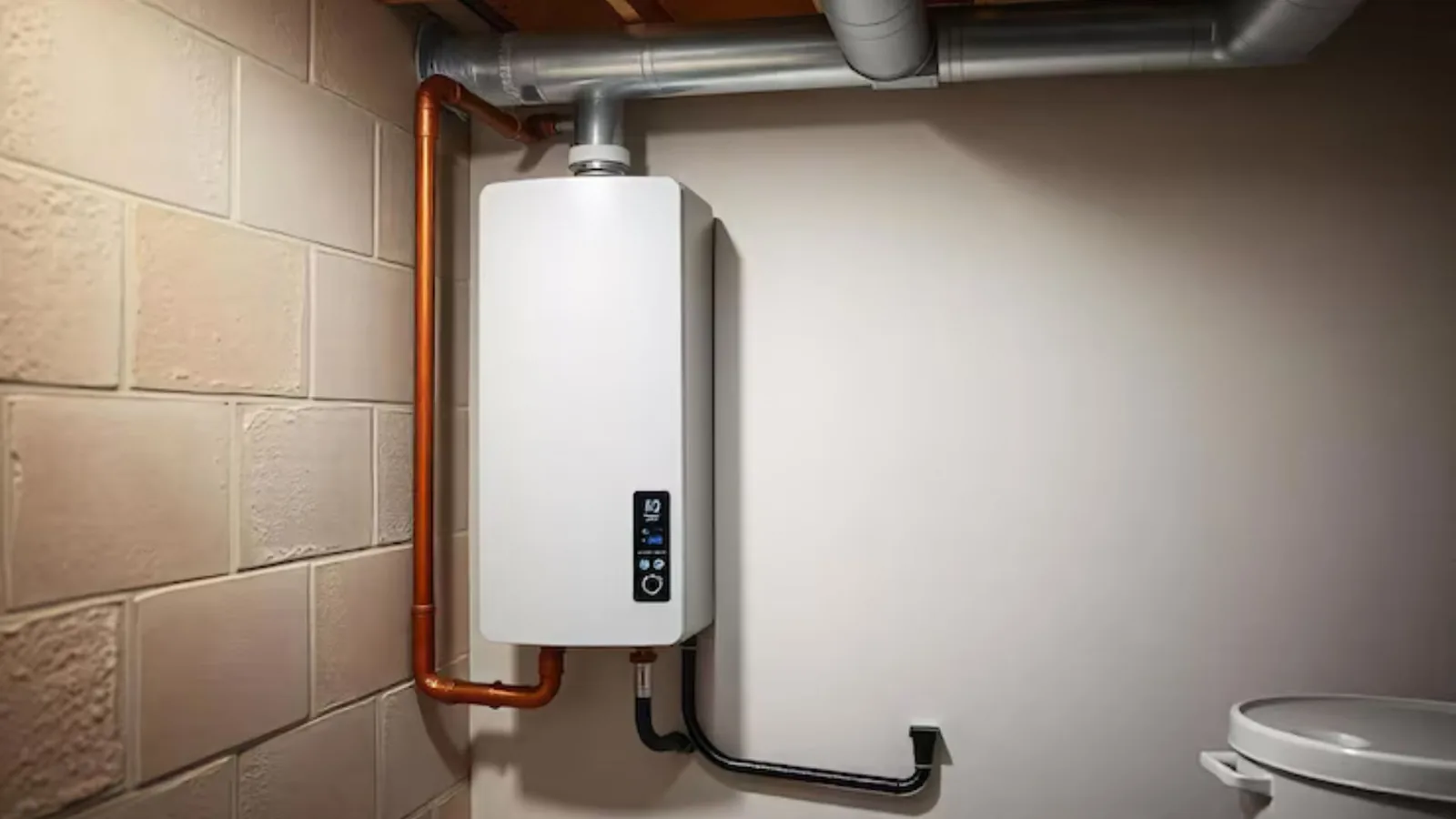
A tankless water heater in Frankfort, KY heats water as it flows instead of storing it in a tank. That removes standby heat loss and the risk of a tank flood, and it supplies hot water for as long as the unit can keep up. The trade-off is that tankless units depend on correct sizing, gas or electrical capacity, venting and regular descaling.
We install new units, repair existing ones, convert from a tank, and flush and descale heaters that have lost output. This page is organized around the questions callers ask us most, including when a flush is due, whether a unit can be repaired, and what installation involves.
Signs your tankless heater needs a flush or descale
The most common complaint is a heater that used to deliver steady hot water and now runs lukewarm, cycles on and off, or shows an error code. In many of those cases the heat exchanger has scale on it. Scale insulates the metal, reduces flow and makes the unit work harder than it should.
A flush circulates a descaling solution through the heat exchanger and then rinses it. It is routine maintenance, and it is the cheapest way to extend the life of the unit.
Manufacturer guidelines call for a flush on a schedule that depends on water hardness. Frankfort Plant Board's water quality report does not state a hardness figure, so ask the utility for its current number or test your tap and set your interval from the result.
Common tankless faults and where we look first
- Error codes: we read the code, confirm what it means for your model and test the part it names.
- Lukewarm or fluctuating water: scale, a clogged inlet filter, or a flow sensor that is not reading correctly.
- Unit will not ignite on gas: gas supply, igniter or flame sensor, and venting.
- Cold sandwich effect, where hot water arrives, cools, and then heats again: usually a flow or usage pattern issue we can adjust.
- Noise or vibration: scale, a failing fan or loose venting.
Tank versus tankless for a Frankfort home
| Question | Tank heater | Tankless heater |
|---|---|---|
| Space | Needs a floor footprint | Wall mounted, frees floor space. |
| Upfront work | Simple swap in most homes | May need larger gas line, new venting or electrical upgrade. |
| Maintenance | Annual flush, anode check | Descale on a schedule, clean inlet filter. |
| Hot water supply | Limited by tank size | Limited by flow rate and temperature rise. |
| Failure mode | Tank can leak and flood | Parts fail, usually repairable. |
See our water heater installation page for the tank-side options.
Gas and electric tankless: what each demands from the house
A gas tankless unit burns a lot of fuel quickly, so the gas line serving it must be sized for the full burner input along with every other appliance. Many older homes have a line that was sized for a tank heater and a range. We calculate the load before we quote, because an undersized line is a leading cause of poor tankless performance.
An electric tankless unit needs a large dedicated circuit, often more than an existing panel can spare. In that case the panel work belongs in the scope of the project, and we say so up front rather than after the unit is on the wall.
Venting is the other limit. Condensing gas models vent through plastic pipe, and the run length and termination point must follow the manufacturer's rules. We lay out the vent path and tell you if the wall or the roof will be involved.
How tankless installation and conversion work
Check the load and the lines
We list what the unit must run at once and confirm the gas line or the circuit can supply it.
Plan venting and condensate
We choose the vent route and a drain for condensate, since condensing units produce acidic condensate that must go to a drain.
Mount and connect
The unit is mounted on the wall with service valves so a future flush does not require cutting pipe.
Commission
We test the burner or elements, check the temperature rise, confirm the flow rate, and show you the filter and the flush ports.
What shapes tankless pricing
Unit capacity and model
Larger flow ratings and condensing efficiency cost more.
Gas or electrical upgrades
Upsizing a gas line or adding a circuit can be a large part of the job.
Venting route
A short, straight run is simple. A long run or a roof exit is not.
Service valves and flush kit
Valves that allow flushing are worth installing from day one.
Existing equipment
Removing a tank and patching floors adds labor.
Want a number you can plan around? Call and describe the current heater and the gas or electric service. We price it in writing.
Freeze protection and tankless units
Kentucky winters bring hard freezes. In January the average daily low at Frankfort's Capital City Airport is about 25 degrees Fahrenheit, and past records have dropped well below zero. A tankless unit in an unheated garage or crawl space needs freeze protection, and a power outage during a cold snap can defeat built-in heaters. Keep the unit in a conditioned space where possible, and see our burst pipe repair page for what to do if a line freezes.
If you are weighing a conversion from a tank, our water heater installation page explains the tank side, and our crews in Lawrenceburg and Versailles see the same freeze conditions as Frankfort. A unit that fails in a freeze is a job for water heater repair.
Questions we hear about tankless water heater
Many manufacturers suggest at least once a year, and more often in hard water. Ask Frankfort Plant Board for its current hardness figure or test your tap, then set the interval with that number.
Most faults are repairable, including igniters, sensors, fans, flow valves and scale. Replacement is for a cracked heat exchanger or a unit past its service life.
Colder incoming water means the unit has to add more heat to reach the setpoint, so flow rate drops when demand is high. Scale and a clogged inlet filter make it worse.
Most need electricity for the controls, the fan or both, so they stop when power fails. A generator or battery backup can keep one running.
Yes. We service the common brands and tell you plainly if a part has to be ordered.