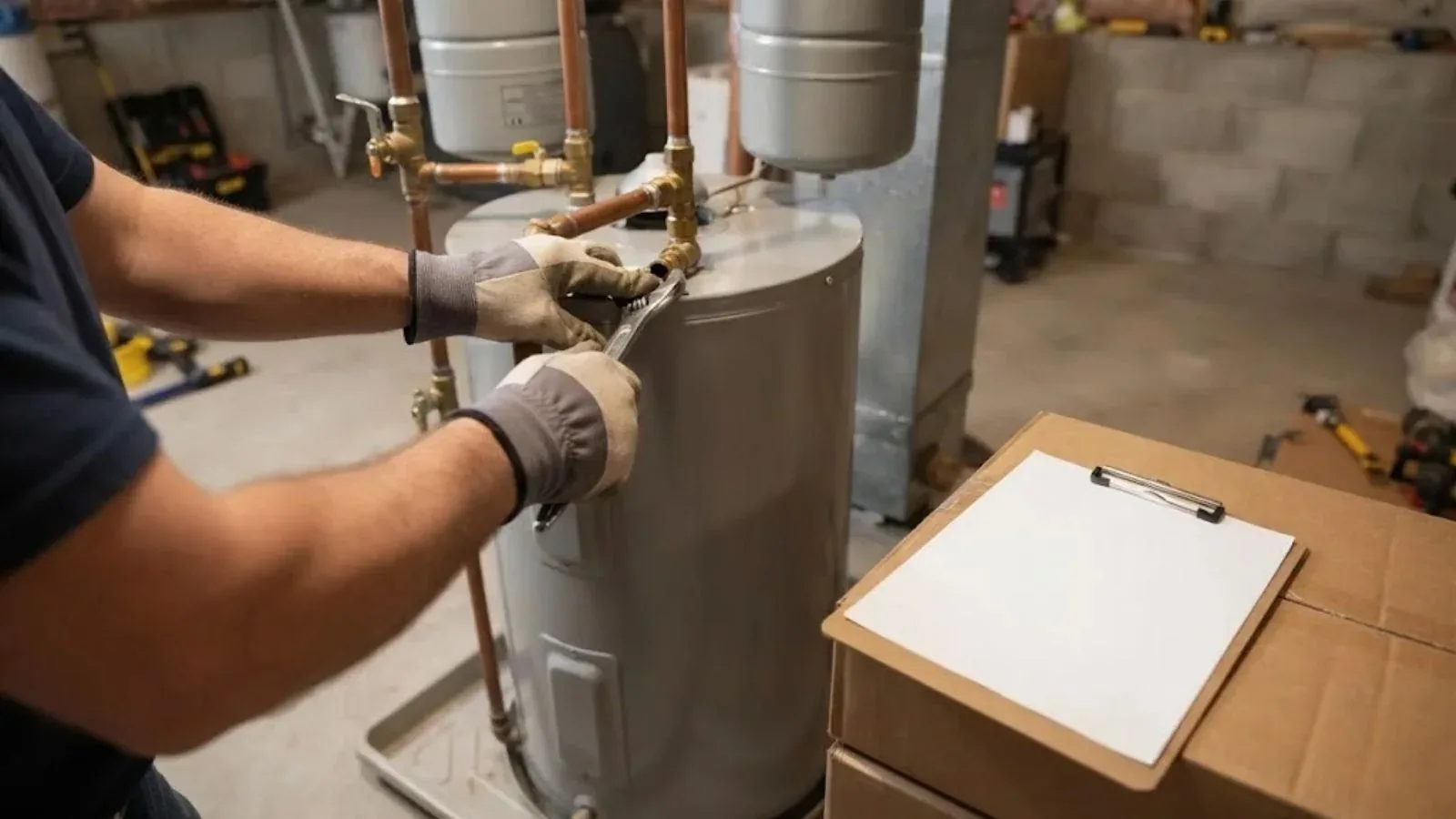
A gas water heater with an electronic igniter lights the burner with a spark or a hot surface. When the igniter wears out, the heater tries to light and fails, and you are left with cold water. The part itself is small and the replacement is not complex. The risk comes from the gas, so a cautious approach is wise.
This guide explains how igniters work, how to tell an igniter fault from other causes, what the replacement involves and why gas safety comes first. If you smell gas at any time, leave the house and call 911 and your gas utility before doing anything else.
Gas safety rules before any repair
- If you smell gas, do not touch switches, light a flame or use a phone inside. Leave the house and call 911 and your gas utility from outside.
- Turn the gas control to off and wait several minutes before working near the burner, so any gas disperses.
- Never bypass a safety device, such as a flame sensor or thermocouple, to get hot water faster.
- Check that the vent is connected and not blocked before relighting the heater.
- If the heater has been flooded or has water on the control, do not use it. Call a plumber.
Why a gas water heater will not light
| Cause | What you see | Who fixes it |
|---|---|---|
| Worn igniter | Clicking or glowing, no flame | Replace the igniter. |
| Dirty or failing flame sensor | Lights, then shuts off after a few seconds | Clean or replace the sensor. |
| Gas supply interrupted | No gas noise at the burner | Check the valve, then call the utility if needed. |
| Blocked vent or draft problem | Heater shuts off or burner flames roll out | Do not operate. Call a plumber. |
| Bad gas control valve | Nothing responds | Replace the control. |
| Dead battery in a control | Display dark | Replace the battery. |
How an igniter replacement works
Shut off and wait
We turn the gas control off, close the gas valve to the heater and wait for any residual gas to clear.
Open the burner compartment
We remove the access cover and the burner assembly where needed.
Test the old igniter
We test it with a meter to confirm it is the failed part.
Install the new igniter
The new part mounts in the same bracket, sits at the correct distance from the burner and connects to the control.
Relight and check combustion
We restore the gas, check for leaks with a solution at every joint, watch the flame and confirm the vent has a good draft.
Why we test the vent every time
A gas heater exhausts combustion gases through a vent. If the vent is blocked, disconnected or damaged, those gases can enter the house, and carbon monoxide is a danger. A carbon monoxide alarm near the heater and on each level of the house is a sensible precaution.
The National Fuel Gas Code, published as NFPA 54, is the model standard for gas appliance venting and piping, and your building department can say which edition applies. A repair that ignores the vent is incomplete. Our water heater repair visits include a draft check, and if the unit is old or damaged, we explain when replacement is the safer choice.
When replacing the whole heater makes more sense
An igniter is a small part on an otherwise healthy heater. If the tank is leaking, rusted or well past its typical life, spending money on parts is not a good use of funds. Look at the date code on the rating plate, and note any water at the base or rust at the bottom of the tank.
If your heater is more than about a decade old and has multiple problems, ask for a replacement quote at the same time as a repair quote so you can compare. See water heater installation for planned work.
Pilot lights, hot surface igniters and spark ignition
Older gas water heaters use a standing pilot, which is a small flame that stays lit and warms a thermocouple. Newer ones use a hot surface igniter, a ceramic element that glows to light the burner, or a spark igniter that works like a lighter. Knowing which system you have tells you which part to suspect.
A standing pilot that keeps going out usually points to the thermocouple or to a draft. A hot surface igniter that glows but never lights the burner may have a weak glow or a gas supply problem. A spark system that clicks without a flame may have a fouled electrode. The label on the heater and the model number show which system applies.
Gas service in the Frankfort area
Columbia Gas of Kentucky publishes its 24/7 gas emergency number as 1-800-432-9515 on its website. Check your bill to confirm that Columbia Gas is your provider, since some homes outside the city use propane tanks and different suppliers. If you smell gas, call your provider and 911 from a safe place outside.
Gas permit rules vary by address, so ask your local building department. Our pages for Versailles and Lawrenceburg describe service in nearby towns, where propane is also common.
Source type: gas utility published emergency guidance
Questions we hear about gas water heater igniter replacement
It is possible for experienced homeowners, but it involves gas. If you are not sure, hire a professional.
A weak thermocouple, a draft or a dirty orifice is the usual cause. Do not keep relighting. Call us.
Yes. Leave, call 911 and your gas utility, and do not return until cleared.
Many last several years, though life varies with use and conditions. A heater that has trouble lighting repeatedly may be nearing the end.
The part and the settings differ. Tell us the fuel and the model so we bring the right one.