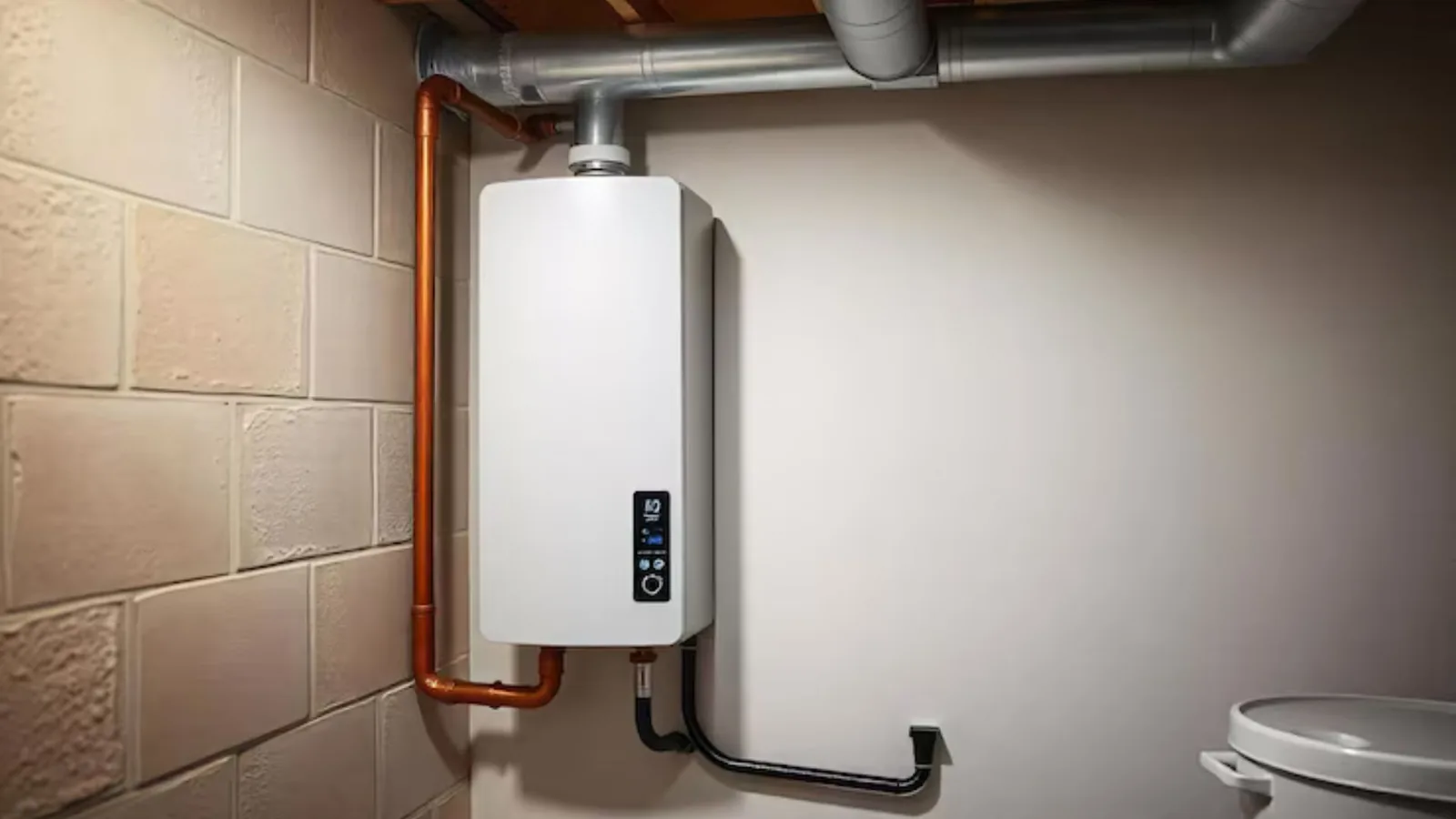
Radiant floor heat circulates warm water through tubes in or under the floor. Some homeowners ask whether a tankless water heater can supply both the taps and the floor loop. The answer is yes for certain combination units that are designed for it, and no for most standard tankless units. Using the wrong heater can void the warranty and can put untreated water into a closed loop.
This guide explains the main system layouts, what to ask a manufacturer and why a planned design matters more than the equipment price. It does not replace a design by a licensed professional, and it does not cover every possible layout.
Three ways to run radiant heat with hot water
| Layout | How it works | Points to check |
|---|---|---|
| Open loop | Domestic hot water runs directly through the floor loop | Many codes and manufacturers restrict this because the water can stagnate and carry contaminants. |
| Closed loop with a heat exchanger | A heat exchanger separates domestic water from the floor loop | Needs a heat exchanger and a circulation pump. |
| Combination boiler | A boiler designed for both space heat and domestic hot water | Often the cleanest design for new construction. |
| Separate boiler for the floor loop | A dedicated boiler runs the loop and a tankless unit handles taps | Clear separation, more equipment. |
Why a standard tankless unit is not enough
A tankless heater is built to raise the temperature of water that flows through it once. A radiant loop recirculates water over and over, and it demands steady heat for hours. The two duties are different, and a unit rated for domestic hot water only may not carry a long space heating load.
A unit that is used outside its design can short-cycle, wear out its heat exchanger early or fail to meet the load on a cold day. Some manufacturers publish combination models rated for space heating and domestic hot water together. Ask for the data sheet that states radiant heating as an approved use.
Questions to answer before you buy equipment
- What is the heat load of the area, based on a calculation and not a guess?
- Does the manufacturer list radiant floor heat as an approved use for this model?
- Will the design use a heat exchanger or a closed loop with antifreeze or treated water?
- Is there a gas line, a vent route and the electrical supply the unit needs?
- How will you drain and flush the unit, and where will condensate go?
- What happens in a power outage? A circulating pump and a control board both need power.
How we approach a design
Our crews install tankless units, and the tankless water heater page lists what we check. For a whole system design, we coordinate with an HVAC contractor where the heating side needs specialist work.
Define the load
We start from the heat loss of the area and the hot water demand of the house.
Pick the layout
We decide between a combination boiler and a separate system, based on cost, space and how the loop will be controlled.
Plan the piping
The supply and return piping, the pump, the expansion tank, air removal and the controls are laid out.
Install and commission
We fill, purge and pressure test the loop, set controls and confirm the system reaches the target temperatures.
Document
You get a record of the settings and the maintenance schedule.
Scale, water quality and long-term care
Closed loops reduce scale because the same water circulates. The domestic side of a tankless unit still sees fresh water and scales over time, so a flush on a schedule is a must. Frankfort Plant Board's published water quality report does not give a hardness figure, so ask the utility or test your tap, then set the flush interval.
Floor type, tube spacing and water temperature
Radiant floors differ in how fast they respond. Tubes embedded in concrete store heat and respond slowly, while tubes under a wood subfloor respond faster but need hotter water. The floor covering matters too, since tile moves heat well and thick carpet slows it down.
Water temperature in the loop affects efficiency. Lower loop temperatures work with condensing equipment, and mixing valves hold the loop at the right setting while the heater runs hotter. A designer sets these numbers from the floor type, so they are not left to guesswork.
Winter conditions around Frankfort
At Capital City Airport the average January low is about 25 degrees Fahrenheit, and the record low is far below zero. Downtown readings run a few degrees colder. A radiant system is a way to keep a floor warm in that climate, and a design should account for the coldest nights and for power outages that stop a pump.
For homes in Versailles or Midway, see our pages for Versailles and Midway for the towns we serve. Ask your local building department which codes apply to a combined heating and plumbing installation at your address.
Source type: National Weather Service climate normals and local building department guidance
Questions we hear about tankless water heater for radiant heat
No. Only models that the manufacturer approves for space heating, and those in a design that meets code, should be used.
Rules and manufacturer terms vary. Many restrict it. Ask the manufacturer and the local code office before choosing it.
Usually yes, but it serves both jobs. The decision depends on the house and the budget.
Yes. The domestic side of the unit needs a scale flush, and the loop needs its water checked on a schedule.
We install the plumbing side and coordinate with heating specialists where needed.